






 Global
  United States
 Japan
Japan 






In this Blog
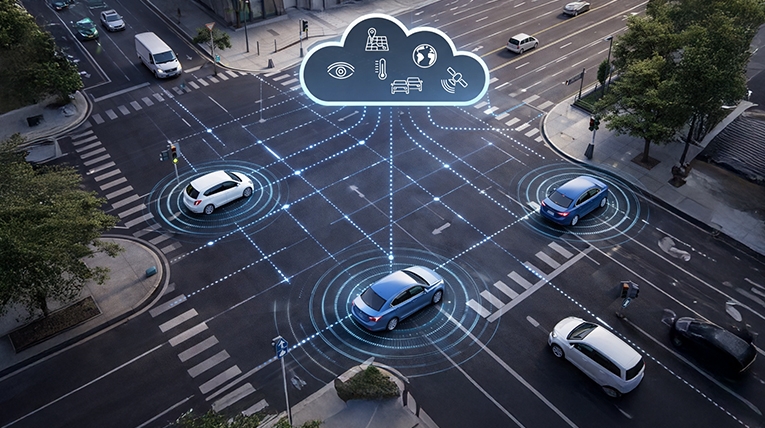
The automotive industry is undergoing a fundamental transformation as vehicles evolve from hardware-centric machines into dynamic, software-driven platforms. Software-Defined Vehicles (SDVs) represent this shift, where software not hardware defines vehicle capabilities, user experience, and long-term value. In an SDV, functionality is no longer frozen at the time of vehicle production; instead, it evolves continuously throughout the vehicle lifecycle through software updates, new applications, and service enablement.
This transition is driven by the convergence of high-performance computing, vehicle connectivity, cloud infrastructure, and consumer expectations shaped by smartphones and digital ecosystems. AI/ML further accelerate this shift, enabling more personalized in-vehicle experiences and allowing vehicles to improve continuously through data-driven insights. In practice, SDVs rely on modular software architectures, in-vehicle app marketplaces, and new monetization models that redefine how OEMs design, deploy, and profit from vehicles.
From ECU-Centric Vehicles to Software Platforms
Traditional vehicle architectures were built around tightly coupled Electronic Control Units (ECUs), each designed for a specific function and developed largely in isolation. Software in this model was deeply embedded, hardware-dependent, and rarely updated once the vehicle left the factory. As vehicle complexity increased particularly with ADAS, infotainment, and connectivity this approach became unsustainable.
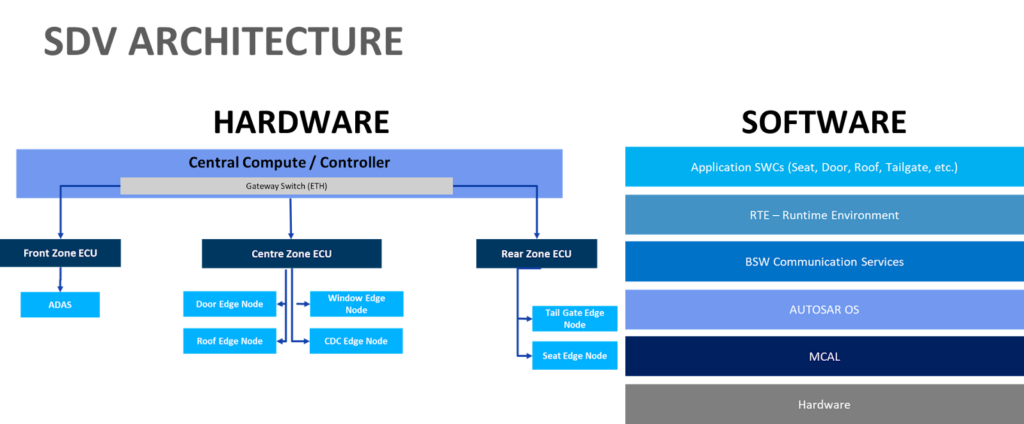
SDVs replace this rigid architecture with centralized or zonal compute platforms, where multiple vehicle functions run as software services on high-performance processors. Hardware becomes a more standardized execution platform, while software is abstracted, reusable, and continuously updatable. This decoupling allows OEMs to shorten development cycles, deploy features post-sale, and respond rapidly to regulatory, market, and customer demands.
Modular Software Architectures as the Foundation of SDV
At the heart of SDVs lies modular software architecture. Rather than monolithic applications, vehicle software is decomposed into well-defined modules and services, each with clear responsibilities and interfaces. This modularity enables parallel development, independent validation, and selective deployment of features across vehicle variants.
Modern SDVs typically implement layered architectures, starting with a hardware abstraction layer that shields applications from underlying hardware changes. Above this sits a real-time operating system or POSIX-compliant OS, followed by middleware that manages communication, service discovery, and data exchange. Frameworks such as AUTOSAR Classic and AUTOSAR Adaptive play a critical role here by standardizing interfaces, execution models, and safety mechanisms across vehicle platforms.
Increasingly, OEMs are adopting microservice-oriented designs and containerized execution environments primarily for non-safety-critical workloads applications. Services such as navigation, media processing, vehicle diagnostics, and energy management can be deployed, updated, or scaled independently. Hypervisors and virtualization technologies allow safety-critical and non-critical applications to coexist securely on the same hardware, supporting mixed-criticality systems while maintaining ISO 26262 compliance.
Safety and Cybersecurity in a Modular SDV World
While modularity brings agility, it also introduces new safety and security challenges. Each software module must operate within strict safety boundaries, and faults must be contained without affecting other vehicle functions. SDVs address this through isolation mechanisms such as memory protection, partitioned execution, and watchdog supervision.
Cybersecurity becomes equally critical as vehicles expose APIs, connect to cloud services, and support third-party applications. Secure boot chains, hardware security modules, trusted execution environments, and encrypted communication channels form the backbone of SDV security. Compliance with ISO/SAE 21434 ensures that cybersecurity is embedded throughout the software lifecycle, from design and development to deployment and updates.
In-Vehicle App Stores: Extending the Vehicle Ecosystem
One of the most visible manifestations of SDVs is the emergence of in-vehicle app stores. These platforms transform vehicles into extensible ecosystems where new features and services can be downloaded long after the vehicle is sold. Unlike consumer smartphones, however, automotive app stores must operate under stringent safety, security, and reliability constraints.
From an architectural standpoint, an in-vehicle app store consists of a cloud-based marketplace backend and a secure in-vehicle runtime environment. The backend manages application catalogs, developer onboarding, certification workflows, and digital rights management. On the vehicle side, applications run in sandboxed environments with tightly controlled access to vehicle data and functions.
Applications interact with vehicle services through standardized APIs, ensuring that sensitive resources such as sensors, vehicle controls, and personal data are accessed only with explicit permissions. OTA delivery mechanisms handle installation, updates, and rollback, ensuring that failed updates do not compromise vehicle operation.
OTA as the Enabler of Continuous Vehicle Evolution
Over-the-air (OTA) updates are the operational backbone of SDVs. OTA enables OEMs to deploy new features, fix bugs, address security vulnerabilities, and even introduce entirely new business models without physical recalls or workshop visits.
Technically, OTA systems must handle differential updates, cryptographic validation, version compatibility, and safe rollback mechanisms. Safety-critical updates are often staged and validated in controlled phases, while non-critical updates can be deployed more dynamically. In zonal and centralized architectures, OTA orchestration becomes more complex, requiring coordinated updates across multiple software services and domains.
Monetization Models Enabled by Software-Defined Vehicles
SDVs fundamentally change how vehicles generate revenue. Instead of relying solely on one-time hardware sales, OEMs can adopt recurring and usage-based monetization models. Software-enabled feature subscriptions allow customers to activate advanced driver assistance, performance enhancements, or comfort features on demand. These subscriptions are enforced through entitlement management systems integrated with cloud platforms and in-vehicle software.
Pay-per-use models further extend monetization by allowing customers to pay only when they use specific services, such as premium navigation features or temporary autonomy upgrades. App stores introduce revenue-sharing opportunities with third-party developers, creating ecosystems similar to mobile platforms. These automotive app stores are controlled by OEMs.
Additionally, SDVs enable data-driven monetization through anonymized vehicle data analytics, predictive maintenance services, and personalized offerings provided privacy and regulatory requirements are strictly adhered to.
Testing and Validation in the SDV Era
The dynamic nature of SDVs demands a rethinking of testing and validation strategies. Continuous integration and deployment pipelines must be supported by Software-in-the-Loop (SIL), Hardware-in-the-Loop (HIL), and Model-in-the-Loop (MIL) environments. These setups validate software behavior across updates, configurations, and failure scenarios.
Testing extends beyond functional validation to include OTA robustness, cybersecurity resilience, performance under network constraints, and long-term reliability. Automated regression testing becomes essential as software updates are deployed throughout the vehicle’s lifecycle.
VVDN’s Capabilities in Software-Defined Vehicles
VVDN plays a critical role in enabling OEMs and Tier-1 suppliers to realize SDV programs at scale. With deep expertise in automotive software architecture, VVDN supports the design and implementation of modular, service-oriented SDV platforms aligned with AUTOSAR Classic and Adaptive standards.
VVDN delivers end-to-end capabilities across centralized and zonal compute architectures, including middleware integration, virtualization, and mixed-criticality system design. The company has strong experience in building secure OTA frameworks, feature lifecycle management systems, and cloud-to-vehicle integration pipelines.
In the app store domain, VVDN supports marketplace architecture design, secure API frameworks, sandboxed application environments, and integration of billing and entitlement systems. Its testing infrastructure spans SIL, HIL, and MIL setups, enabling comprehensive validation of SDV software, OTA updates, and monetization workflows. VVDN also brings cybersecurity expertise aligned with ISO/SAE 21434, ensuring that SDV platforms remain secure throughout their operational life.